When compaction verification falls under BS EN 1997-2:2007 and BS 1377-4, the sand cone method remains the most practical direct measurement for earthworks across Bristol. The city sits on a complex interface between the Mercia Mudstone Group, Blue Lias clays, and extensive made ground that covers much of the Avon valley. What makes field density testing particularly relevant here is the sheer volume of brownfield redevelopment, where historic fill materials demand rigorous compaction control before any structural load can be applied. Working from our laboratory near Temple Meads, we routinely encounter sites where the natural ground transitions from weathered mudstone to alluvial gravels within the same plot, something the desk study rarely captures fully.
This variability means that a single compaction specification cannot be applied blindly across Bristol, and we often recommend pairing the sand cone density verification with Proctor tests to establish valid reference curves for each distinct material layer encountered on site.
A single sand cone test tells you the density of one lift; a properly spaced grid tells you whether the roller operator actually achieved uniformity across the entire footprint.
How we work
The calibrated sand is then allowed to flow from the jar into the test hole through the base plate aperture, filling the excavation completely without vibration or tamping. The volume of sand consumed, measured by the drop in the jar, gives the volume of the test hole directly. Dividing the moist mass of the excavated material by this volume yields the wet density, and a representative sample is sealed for moisture content determination back at the lab. In the St Philip's area and around the Floating Harbour, where groundwater can be perched in fill at less than a metre depth, we frequently combine this with in-situ permeability testing to understand how water movement might affect long-term compaction stability.
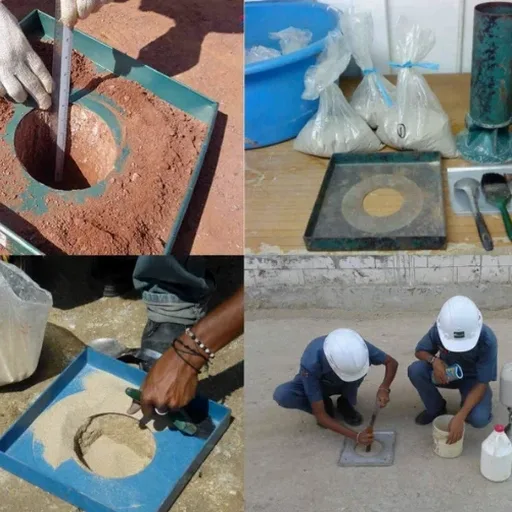
Local ground factors
The contrast between the deep alluvial clays underlying Bedminster and the limestone-derived brash soils up in Clifton illustrates why a single compaction strategy rarely works across Bristol. In Bedminster and the lower Avon floodplain, soft cohesive fills and natural alluvium compact poorly if placed wet of optimum, leading to low dry densities that manifest later as differential settlement beneath floor slabs and approach roads. Conversely, the granular made ground common around Temple Quarter and the former industrial yards near Lawrence Hill can achieve high relative compaction with minimal effort, but the material is often so free-draining that moisture content control becomes irrelevant, and the larger challenge is preventing segregation during placement.
Omission of systematic field density testing on layered fills introduces a risk that isolated loose pockets remain undetected between apparently compliant lifts, and these weak zones can initiate progressive deformation once the structure begins to impose its full service load.
Relevant standards
BS EN 1997-2:2007 (Eurocode 7: Geotechnical design - Ground investigation and testing), BS 1377-4:1990 (Methods of test for soils for civil engineering purposes: Compaction-related tests), BS 1924-2:1990 (Stabilized materials for civil engineering purposes: Methods of test for cement-stabilized and lime-stabilized materials), Manual of Contract Documents for Highway Works (MCHW) Series 600: Earthworks
Related services
Compaction Verification Testing
Sand cone density tests on engineered fill per Series 600 of the MCHW, with direct comparison to Proctor reference values, covering general fill, capping, and structural fill layers.
Nuclear Density Gauge Correlation
Paired sand cone and nuclear gauge measurements on the same test points to develop site-specific calibration curves, allowing faster coverage once the correlation is validated.
Trench and Pipeline Backfill Control
Targeted in-situ density testing around service trenches, drainage alignments, and culvert backfills where limited access demands smaller test patterns and careful interpretation.
Remediation Fill Verification
Density control on treated and recompacted made ground across Bristol's brownfield sites, with reporting structured for NHBC and local authority building control acceptance.
Typical parameters
Common questions
How much does a field density test using the sand cone method cost in Bristol?
A single sand cone density test typically falls within £80 to £130, depending on site location within Bristol, the number of tests scheduled per visit, and whether Proctor reference curves need to be established first. A full day of compaction testing with multiple points generally offers better value per test.
How many sand cone tests are needed on a typical Bristol residential plot?
Frequency is driven by the earthworks specification, usually one test per lift per 250-500 m² of placed fill. On a standard residential plot in Bristol with a 100 mm compacted lift, that often translates to 4 to 8 tests per lift, with frequency increasing near foundation zones and service trench alignments.
Can the sand cone method be used on coarse fill containing brick rubble and demolition debris?
Yes, with limitations. BS 1377-4 specifies that the sand cone method is suitable for materials with a maximum particle size up to about 37.5 mm. For coarser demolition rubble common in Bristol's made ground, the test hole volume must be increased, and the result is treated as an indicative rather than a precise measurement, often supplemented by larger-scale methods or observational compaction criteria.