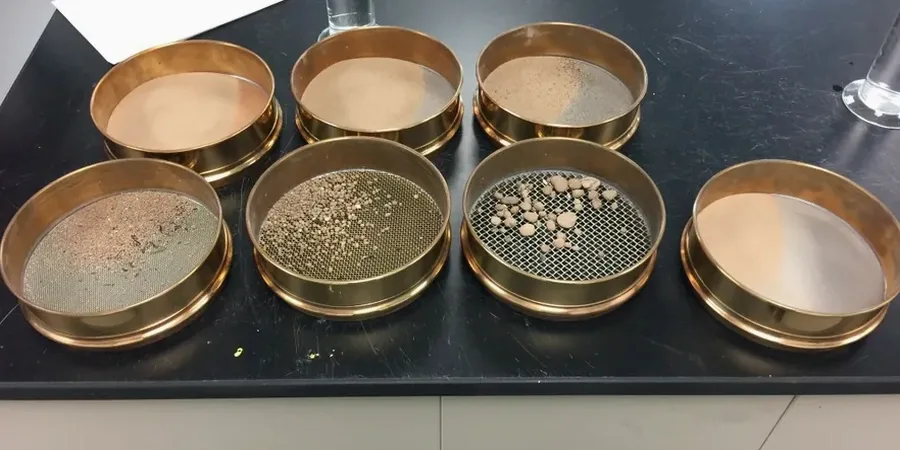
The geology between Clifton and Avonmouth tells a story of dramatic particle size shift. Up on the Carboniferous limestone ridge, residual soils are coarse and gritty, while the alluvial clays near the Floating Harbour carry fine silts deposited by the Avon and Frome rivers. A single borehole log cannot capture this gradation contrast. Our laboratory in the Bristol area runs the full hydrometer and sieve analysis under BS EN ISO 17892-4, producing a continuous curve from the 75 mm sieve down to the 2-micron clay fraction. For schemes in the Temple Quarter Enterprise Zone or on the Mercia Mudstone slopes of Totterdown, we combine this with Atterberg limits to pin the plasticity range of the fines and confirm classification per BS 5930. The output feeds directly into drainage layer design, frost heave assessment, and compaction specification.
A missing hydrometer reading on a Bristol Lias Clay fill can misclassify a CH as a CL, shifting the design permeability by two orders of magnitude.
How we work
Local ground factors
The Severn Estuary’s tidal influence pushes a wedge of saline groundwater into the Avon floodplain twice daily, altering the settlement velocity of fines during sedimentation tests if the sample is not properly washed. A hydrometer analysis run on untreated estuarine clay from the Portway or Shirehampton area can yield a false clay fraction because flocculation skews the settling rate. Our Bristol protocol pre-washes every sample through the 63 µm sieve until the wash water runs clear, then applies the dispersant in deionised water only. On the steep colluvial slopes of the Avon Gorge, where Head deposits mix rock fragments with a silty matrix, the gradation curve is essential to distinguish a well-graded granular fill from a gap-graded material prone to internal erosion. Missing that distinction has led to drain blockages in retaining structures across the city.
Relevant standards
BS EN ISO 17892-4:2016 — Geotechnical investigation and testing. Laboratory testing of soil. Part 4: Determination of particle size distribution, BS 5930:2015+A1:2020 — Code of practice for ground investigations, BS 1377-2:2022 — Methods of test for soils for civil engineering purposes. Classification tests and determination of geotechnical properties
Related services
Full Gradation Package (Sieve + Hydrometer)
Wet preparation, sieving from 75 mm to 63 µm, and sedimentation hydrometer per BS EN ISO 17892-4. Includes the grading curve, uniformity and curvature coefficients, and the percentage gravel/sand/silt/clay fractions. Used for soil classification to BS 5930, drainage media specification, and assessing frost susceptibility of subgrade soils on residential schemes in South Gloucestershire.
Particle Size Distribution for Earthworks Compliance
Comparative gradation analysis before and after compaction, linked to the Proctor reference curve. We test samples from fill stockpiles and placed layers on MCHW Series 600 earthworks, verifying that the as-placed material falls within the specified grading envelope. Essential for Section 278 agreements and adoption sign-off on new estate roads across Bristol.
Typical parameters
Common questions
What does a grain size analysis cost for a site in Bristol, and what influences the price?
For a single sample with full wet-sieve and hydrometer sedimentation to BS EN ISO 17892-4, budget between £70 and £160. The spread depends on whether we are testing a clean sand that needs only a dry sieve, or a silty clay from the Mercia Mudstone that requires extended sedimentation readings over 24 hours. The number of samples, the need for expedited reporting, and the inclusion of pre-treatment for organic or saline content also shift the final figure. We quote per batch with a fixed rate that covers sample preparation, dispersant, temperature correction, and the signed test certificate.
How long does the hydrometer test take, and can you rush it for a Bristol deadline?
A full hydrometer sedimentation run requires readings at 0.5, 1, 2, 4, 8, 15, 30, 60, 120, 240, and 1440 minutes, so the physical test spans a minimum of 24 hours. Add wet preparation, sieving, oven drying, and data reduction, and the standard report is ready in 5 working days. For Bristol city-centre schemes with a tight contractor programme, we offer a 48-hour express service that prioritises your samples in the lab queue without shortening the sedimentation period.
Why do I need the hydrometer if the sieve analysis already gives me the sand and gravel percentages?
The sieve stops at 63 microns; everything finer is pan material. On Bristol's Lias Clay and alluvial deposits, the pan fraction can be 40 to 70 percent of the total mass, and its behaviour, drainage, frost heave, and shrink-swell potential are governed by the clay content below 2 microns. The hydrometer alone quantifies that clay fraction, distinguishes a silt from a clay, and gives you the D10 and D60 needed for permeability estimates and filter design. Without it, a CL and a CH look identical on the sieve report, but they perform completely differently under load or water.