Bristol's elevation ranges from 10m at the Floating Harbour to over 110m in Clifton, and that gradient creates some of the most complex excavation conditions in the South West. When you're digging near the Avon Gorge or cutting into the Triassic Mercia Mudstone that underlies much of the city centre, the difference between a controlled dig and a costly setback comes down to one thing: reliable monitoring data. Our team deploys Bristol-focused geotechnical excavation monitoring systems that track lateral displacement, settlement, vibration, and pore-water pressure in real time. We've instrumented deep basements in Redcliffe, utility trenches through the carboniferous limestone of the Downs, and retaining structures along the Floating Harbour. Each project starts with a site-specific instrumentation plan that aligns with BS EN 1997-1:2004 and BS 5930:2015, because the geology here shifts block by block. The Mercia Mudstone weathers differently in Bedminster than it does in Stoke Bishop, and the alluvial clays near Temple Meads compress under loads that the limestone at Clifton barely notices. That's why every inclinometer, piezometer, and load cell we install is tied to a digital dashboard accessible from the trailer or the office.
In Bristol's layered geology, monitoring is not a checkbox: it's the instrument that tells you when to stop digging and when to reinforce.
How we work
Local ground factors
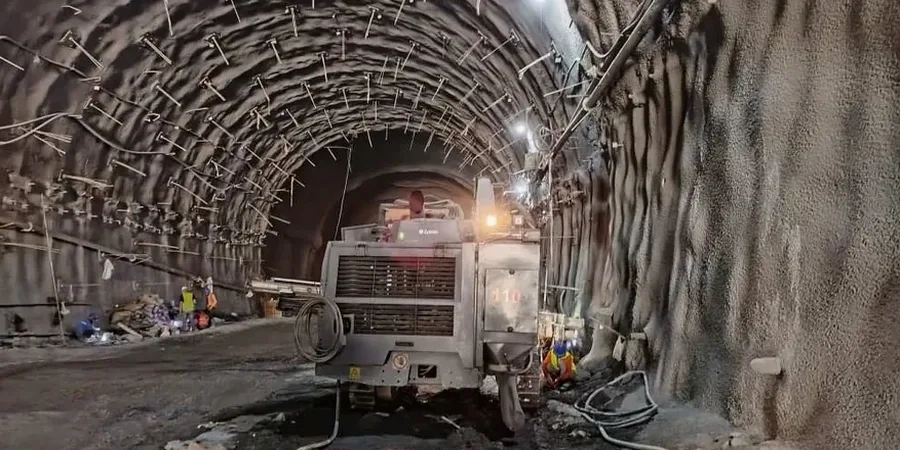
The yellow case of a digital inclinometer gets lowered into a borehole in Bristol's Temple district, and within seconds the probe is reading a deflection of 8mm at 12-metre depth, a movement that started after dewatering began on the adjacent plot. That single reading, captured by a technician on a Tuesday morning, triggers a phone call to the site manager and a revised support sequence before the next concrete pour. This is what monitoring actually does: it converts invisible ground strain into actionable decisions. The main risk in Bristol excavations is not the big collapse you see coming; it's the slow, differential settlement that cracks a Victorian sewer or tilts a listed terrace in Hotwells. Vibrations from rock-breaking in the limestone beneath Clifton can travel further than expected, disturbing sensitive equipment at the BRI hospital complex. Our instrumentation plan includes trigger levels for alert, action, and alarm, calibrated to the structural tolerance of the assets within the zone of influence. If the Mercia Mudstone starts to soften after three days of rain and the piezometers show a 2-metre rise in the water table, we recommend a revised pumping regime before the excavation face slumps.
Relevant standards
BS 5930:2015, BS EN 1997-1:2004, CIRIA C760, ICE Specification for Geotechnical Monitoring
Related services
Real-Time Wall & Ground Movement Monitoring
Automated total stations and in-place inclinometers track deflection of sheet-pile and secant-pile walls, with dashboard access for the project team.
Groundwater & Pore-Pressure Logging
Vibrating-wire piezometers installed inside and outside the excavation capture the response to dewatering and tidal influence near the Floating Harbour.
Vibration & Noise Compliance Monitoring
Triaxial geophones and Class-1 sound meters document compliance with Bristol City Council's construction management plan conditions.
Heritage & Adjacent Building Surveys
Pre-condition surveys with crack meters and tilt sensors on listed structures within the zone of influence, including regular photographic records.
Typical parameters
Common questions
How much does excavation monitoring cost for a typical Bristol basement dig?
For a standard 6–10 metre deep basement in Bristol, monitoring packages typically range from £610 to £1,700 per week, depending on the number of instruments, the reporting frequency, and whether automated data logging is required. A tailored quote is always provided after a site walk and a review of the temporary works design.
What instrumentation is most suitable for excavations in Mercia Mudstone?
In Bristol's Mercia Mudstone, we typically combine in-place inclinometers to track wall deflection with vibrating-wire piezometers to monitor pore-water pressure changes, because this material can soften significantly when wet. Surface settlement points are also essential, particularly where the weathered zone extends deeper than 2 metres.
How quickly can a monitoring system be deployed on a Bristol site?
Basic systems, such as survey prisms and standpipe piezometers, can be operational within one to two working days following instrument delivery. More complex arrays involving in-place inclinometers or automated total stations with telemetry usually require three to five working days for installation, commissioning, and baseline readings, subject to access and weather conditions.