Bristol’s geological profile shifts dramatically within short distances—from the karstic limestone of the Avon Gorge to the deep alluvial deposits of the Floating Harbour basin, where loose sands and silts can exceed 8 metres in thickness. On the former industrial lands of Temple Quarter and along the tidal reaches of the River Avon, the ground often consists of uncompacted fill placed during the 19th and early 20th centuries. These soils pose a direct challenge to any foundation system because they can settle unevenly under load, especially where the water table sits barely 2 metres below street level. Vibrocompaction design addresses exactly this problem by defining a grid pattern that densifies the granular matrix through deep vibration, reducing the void ratio and increasing the relative density to values that meet Eurocode 7 serviceability requirements. When we prepare a treatment specification for a Bristol site, we integrate findings from a CPT test to calibrate the target depth and from grain-size analysis to confirm the soil is suitable for vibratory densification.
A properly designed vibrocompaction grid can double the relative density of loose alluvial sands in a single pass, eliminating the need for deep foundations on many Bristol brownfield sites.
How we work
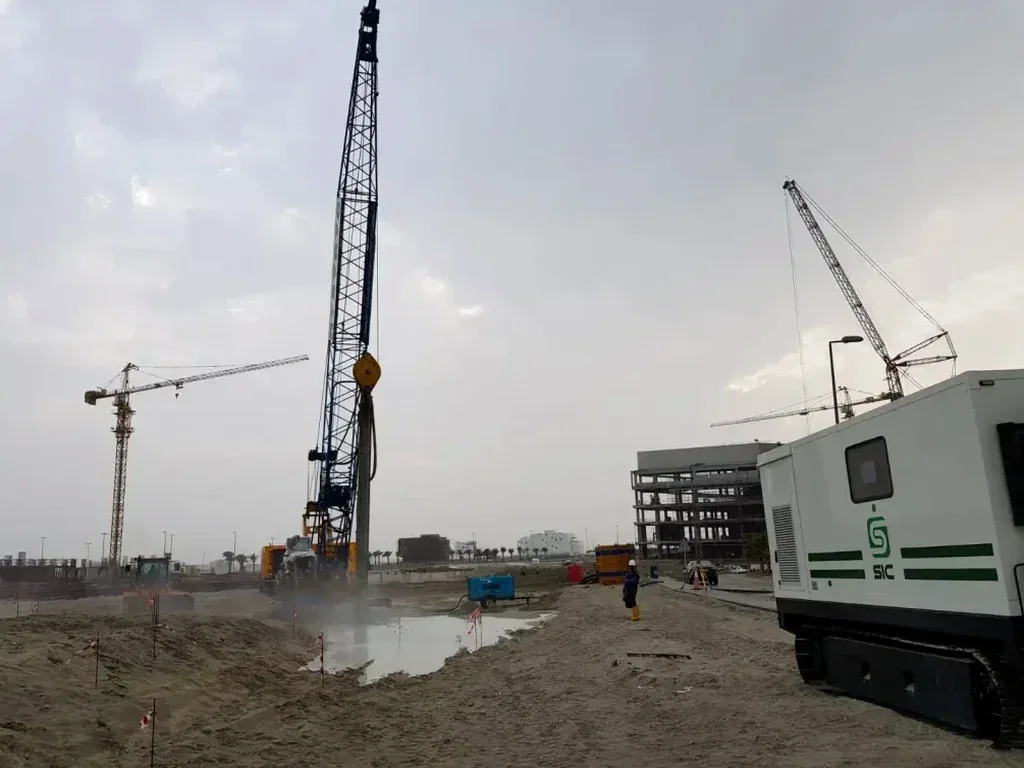
Local ground factors
With a population exceeding 470,000 and a housing delivery target of over 33,000 new homes by 2036, Bristol is under intense pressure to develop land that was previously considered uneconomical to build on. Many of these sites sit on loose estuarine deposits that are susceptible to settlement and, in the event of a rare seismic event in the Bristol Channel basin, to liquefaction. The British Geological Survey has mapped significant thicknesses of potentially liquefiable sand along the Avon floodplain, and while the UK seismic hazard is moderate, the financial exposure of a commercial development in BS1 or BS2 postcodes makes even low-probability risks worth mitigating. A vibrocompaction design that omits verification testing can leave untreated lenses in the soil column, which act as weak spots that concentrate differential movement over time. The cost of retrofitting a settled slab or underpinning a tilted frame dwarfs the investment in a proper treatment programme, which is why our team insists on a phased approach with real-time monitoring of amperage and penetration rate during each probe insertion.
Relevant standards
BS EN 1997-1:2004 (Eurocode 7 – General rules), BS EN 1997-2:2007 (Eurocode 7 – Ground investigation and testing), BS 5930:2015 (Code of practice for ground investigations), BS EN ISO 22476-1:2012 (Field testing – CPT), BRE Special Digest 1 (Sulphate and acid resistance)
Related services
Feasibility Assessment and Trial Design
We review existing ground investigation data and perform a sieve analysis to confirm the soil is granular enough for vibrocompaction. A preliminary grid layout is produced, estimating treatment depth, spacing, and the number of probe points, alongside a settlement prediction using Schmertmann-based methods calibrated to local CPT profiles.
Detailed Treatment Specification and Site Supervision
Our engineers produce a full design package including grid coordinates, vibrator type, target amperage curves, and compaction acceptance criteria. We supervise the initial probes on site, adjusting the design in real time based on the energy consumption and penetration behaviour observed in the first few points.
Post-Treatment Verification and Sign-Off Report
After the compaction programme is complete, we carry out CPT and SPT testing on a specified percentage of the grid nodes to confirm the achieved relative density. The final report presents the before-and-after soil parameters, the settlement analysis, and a statement of compliance with the relevant Eurocode clauses for the Building Control submission.
Typical parameters
Common questions
What type of soil is suitable for vibrocompaction in the Bristol area?
Vibrocompaction works best in granular soils with a fines content below 15%. Much of central Bristol sits on alluvial sands and gravels deposited by the River Avon, which are ideal candidates. If the soil contains too much silt or clay, the vibration energy dissipates without densifying the matrix, and an alternative like stone columns may be more appropriate. We always run a particle-size distribution test first to confirm suitability.
How much does a vibrocompaction design cost for a typical Bristol development?
For a standard commercial or residential scheme in the Bristol area, the design package typically falls between £1,310 and £3,880, depending on the site area, the number of treatment points, and the complexity of the ground profile. This covers the feasibility assessment, the detailed grid specification, supervision of the trial probes, and the post-treatment verification report.
How deep can vibrocompaction treat the ground in Bristol's geology?
With the electric and hydraulic vibrators we specify, treatment depths of 10 to 12 metres are routinely achievable in the loose sands found across the Avon valley. The limiting factor is usually the presence of the Mercia Mudstone bedrock, which in central Bristol can rise to within 5 or 6 metres of the surface. Our design always maps the rockhead from borehole logs to set the maximum probe depth accurately.
How long does the design and verification process take from start to finish?
The design phase typically takes two to three weeks from receipt of the ground investigation data. The treatment itself depends on the rig size and grid density, but for a 1000-square-metre site with probes at 2.5-metre centres, the compaction programme is often completed in three to five working days. Verification testing and the final report follow within a week of treatment completion, so the entire process from instruction to sign-off can fit within a four-to-six-week window.