One of the costliest mistakes a Bristol contractor can make is assuming uniform ground conditions across a site. The geology shifts dramatically from the sandstone ridges of Clifton down to the soft clays of the Floating Harbour area. That assumption leads to undersized foundations or unexpected excavation collapses. The Standard Penetration Test (SPT) cuts through the guesswork, providing a direct N-value profile every 1.5 metres through any overburden. We use automatic trip hammers calibrated to BS EN ISO 22476-3 and deploy crews across BS, BA, and BS postcodes within 48 hours. When the borehole encounters weathered Mercia Mudstone or river terrace gravels, the split-spoon sampler tells us what the trial pit alone cannot. For deeper refusal zones where the SPT stops making progress, we often recommend switching to a CPT test to capture continuous tip resistance and sleeve friction without disturbing the sample.
Bristol's variable bedrock profile means two boreholes 20 metres apart can yield N-values differing by a factor of four. Corelation without local calibration invites error.
How we work
Local ground factors
Bristol sits at the confluence of the River Avon and the Frome, with an elevation that varies from 11 metres AOD at the Floating Harbour to over 100 metres in Clifton and Totterdown. The city's tidal range is the second highest in the world, with a mean spring range of 12.2 metres. This tidal influence means groundwater levels in the central basin fluctuate aggressively, altering effective stress and SPT blow counts seasonally. Boreholes drilled in September can show N-values 15–20% lower than those drilled in March. Ignoring this seasonal effect during a foundation design for a multi-storey block in Bedminster or Southville leads to conservative—and expensive—pile lengths. The competent Carboniferous Limestone that underlies much of the city can also mislead inexperienced drillers: a thin limestone band within the Triassic Mercia Mudstone Group can return high N-values that suggest refusal, when in fact the weaker mudstone continues below. We log every refusal carefully and cross-reference with the British Geological Survey 1:50,000 Sheet 264.
Relevant standards
BS 5930:2015 + A1:2020 — Code of practice for ground investigations, BS EN ISO 22476-3:2005 — Field testing. Standard penetration test, Eurocode 7 — BS EN 1997-2:2007 — Geotechnical design. Ground investigation and testing
Related services
Cable Percussion SPT Boreholes
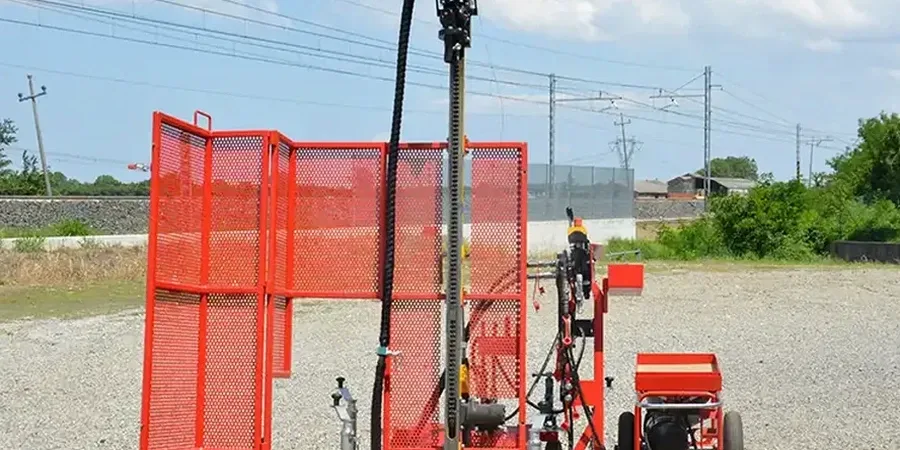
Tracked rig access for tight Bristol sites. Continuous SPT sampling through made ground, alluvium, and Mercia Mudstone with groundwater monitoring standpipe installation.
N60 Energy Calibration
Hammer energy measurement using instrumented rods per BS EN ISO 22476-3 Annex A. Essential when correlating N-values with CPT data for pile design in the Avon Valley.
Combined SPT and Laboratory Testing
Split-spoon samples bagged and sent to our UKAS-accredited lab for particle size distribution, Atterberg limits, and sulphate content testing within 72 hours of drilling.
Typical parameters
Common questions
What does an SPT test in Bristol cost?
For a standard cable percussion borehole with SPT sampling at 1.5 metre intervals to 10 metres depth, the cost ranges from £440 to £640 per borehole. The final figure depends on access conditions, traffic management requirements in central Bristol, and whether groundwater monitoring standpipes are installed. Mobilisation is charged separately and typically adds £250–£350 within the BS postcode area.
How deep do you typically drill for SPT in Bristol?
Depth depends on the target stratum. For a standard two-storey residential extension on Mercia Mudstone we typically reach 6–10 metres. For larger structures in the Floating Harbour basin where soft alluvium overlies bedrock, boreholes often extend to 20–25 metres to confirm competent Carboniferous Limestone or mudstone at depth.
How long until I receive the SPT logs and report?
Field logs are available same-day as a PDF. The full factual report with corrected N60 values, groundwater observations, and BGS geological correlation is delivered within five working days. We can fast-track to 48 hours for urgent foundation redesign situations.
Can you access restricted sites in central Bristol?
Yes. We operate a compact tracked cable percussion rig that fits through a standard 1.2 metre gate opening and can work on slopes up to 20 degrees. For terraced properties in areas like Redland or Cotham with no rear access, we use a portable dynamic sampling set-up that requires only 800 millimetres of clearance.