Too many projects around Bristol still treat foundation design as a copy-paste exercise from the last job in Swindon. The city sits on a geological patchwork—Carboniferous limestone in Clifton, Mercia Mudstone in Redland, and pockets of soft alluvium along the Avon floodplain. A standard 600 mm strip footing won’t cut it everywhere. When ground conditions vary over less than 50 metres, the difference between a straightforward build and a costly remedial job comes down to the site-specific bearing capacity assessment. We’ve seen pads designed without accounting for the weathered mudstone interface fail within two years. The solution starts with a test pit programme that recovers undisturbed samples, followed by lab work that feeds directly into the allowable bearing pressure calculations. Getting the foundation right from the start saves six figures further down the line.
A site-specific bearing capacity assessment in Bristol can double the allowable pressure compared to a conservative desktop estimate—saving concrete and excavation costs.
How we work
Local ground factors
Bristol’s post-war expansion pushed housing onto less favourable ground—former brick pits in St George, infilled docksides, and the sloping Lias clay terraces that run south from Totterdown. These areas carry a legacy of variable fill and perched water tables that create differential settlement risks for shallow foundations. A 1950s semi-detached on strip footings might have settled uniformly over decades, but a modern two-storey extension with deeper foundations and higher point loads behaves differently. The risk isn’t total collapse—it’s the slow, expensive cracking that appears two years after completion. We mitigate this through targeted ground investigation, specifying rafts or reinforced strips where the fill thickness exceeds 600 mm, and designing to a maximum 1:500 angular distortion. The cost of the extra reinforcement is trivial compared to a structural repair claim.
Relevant standards
BS EN 1997-1:2004 (Eurocode 7: Geotechnical design), BS 8004:2015 (Code of practice for foundations), BS 5930:2015+A1:2020 (Site investigation), BS 8500 (Concrete specification for foundations)
Related services
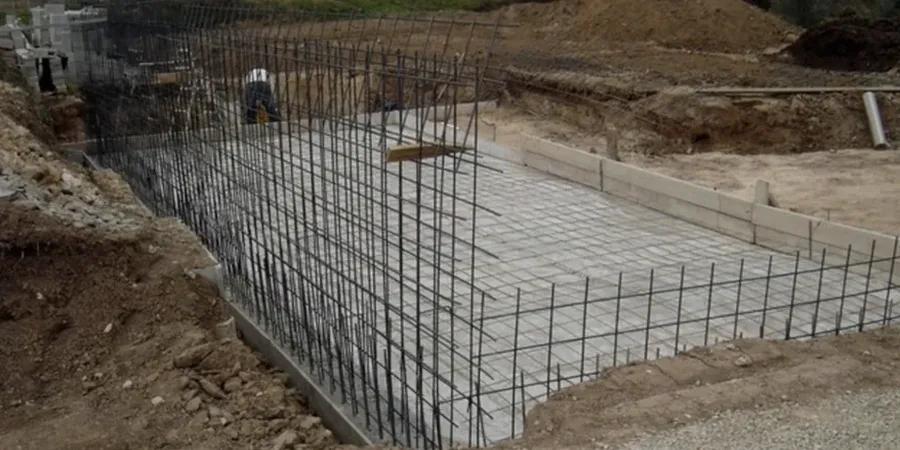
Ground-bearing pad and strip footings
Reinforced and unreinforced spread footings designed to EC7, optimised for Bristol's Mercia Mudstone and limestone conditions. Includes bearing capacity checks, settlement analysis, and reinforcement detailing.
Raft foundation design
Full and cellular raft solutions for soft alluvium sites near the Avon corridor. We model soil-structure interaction to control differential settlement and specify sub-base drainage layers.
Foundation condition assessment
Forensic investigation of existing shallow foundations for extensions and refurbishments. Includes trial pit inspection, concrete coring, and bearing capacity re-evaluation to BS 8004.
Typical parameters
Common questions
How much does a shallow foundation design for a Bristol project typically cost?
For a typical residential or light commercial project in the Bristol area, the design fee ranges from £1,300 to £2,570 depending on the complexity of the ground conditions and the number of foundation elements. This includes the bearing capacity analysis, settlement calculations, and a stamped design package ready for building control submission.
Do I need a site investigation before the foundation design?
Yes. Eurocode 7 mandates that the ground model must be based on adequate investigation data. For Bristol sites, this typically means a combination of test pits or boreholes with laboratory classification and strength testing. We can scope and manage the entire ground investigation for you.
What depth should shallow foundations be in Bristol's clay soils?
In the Mercia Mudstone areas, we typically specify an embedment of 0.9 to 1.2 metres to get below the weathered zone and the depth of seasonal moisture variation. On sloping clay sites south of the river, the depth may increase to 1.5 metres to achieve the required bearing stratum and frost protection.
Can you design foundations on Bristol's filled ground without piling?
In many cases, yes. Where the fill is less than 1.5 metres deep and of reasonable consistency, we can design a reinforced raft or a deep strip footing that bridges the made ground and bears onto the natural strata below. We assess this on a site-by-site basis through trial pitting and CPT profiling.