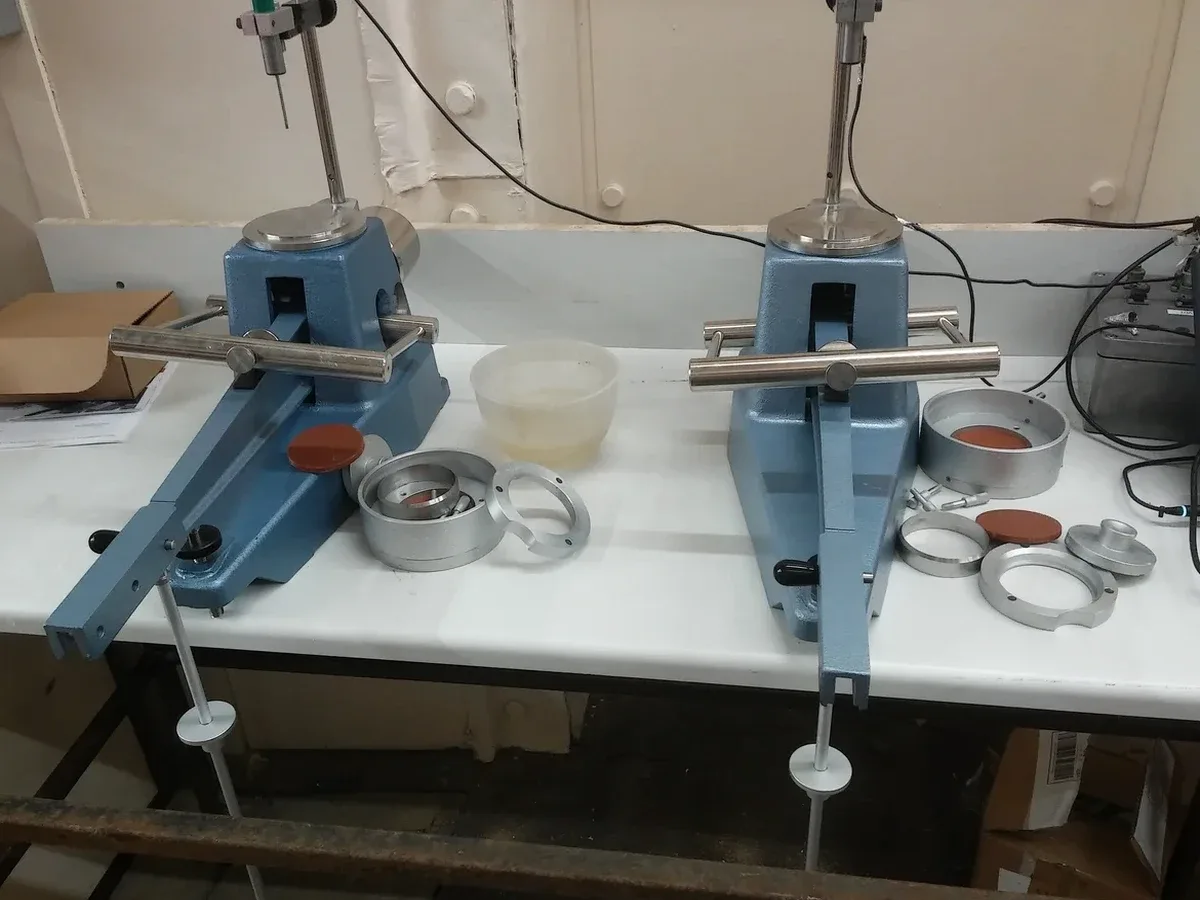
Bristol’s expansion from a medieval port to a modern city has always contended with the underlying geology. The Avon Valley and surrounding areas are underlain by Mercia Mudstone, Lias Clay, and pockets of alluvial deposits that dictate how the ground behaves when wet. For any cut, fill, or foundation in these materials, the Atterberg limits test becomes essential. It quantifies the moisture contents at which fine-grained soils transition from solid to plastic to liquid states. Without this data, a contractor is essentially guessing how much the site will shrink or swell with seasonal weather. Our lab, operating under procedures aligned with BS 5930 and Eurocode 7, provides the liquid limit, plastic limit, and plasticity index that Bristol’s geotechnical consultants and structural engineers depend on for accurate classification and design.
The plasticity index is not just a number on a lab report; it is the single most reliable predictor of how Bristol’s clays will behave under repeated wet-dry cycles.
How we work
Local ground factors
The Severn Estuary’s influence on Bristol creates a damp, temperate climate where clay moisture content rarely stabilises. This makes shrink-swell behaviour a persistent threat for lightly loaded foundations and road subgrades. High-plasticity clays that test at a stiff consistency in summer boreholes can soften dramatically after autumn rains, losing bearing capacity and triggering differential movement. The real danger is overlooking borderline materials — silts that plot close to the A-line on the Casagrande chart. Misclassifying these as silt rather than clay leads to underestimating frost susceptibility and long-term deformation. In Bristol’s redevelopment zones, where Victorian clay brick earth was used as fill, the variability is even greater. Consistent Atterberg limits testing across every borehole and trial pit is not just good practice; it prevents the kind of progressive failure that costs far more to remediate than the lab fees ever did.
Relevant standards
BS 1377-2:1990, BS 5930:2015 + A1:2020, Eurocode 7 (BS EN 1997-2:2007)
Related services
BS 5930 Atterberg Suite
Full determination of liquid limit using the cone penetrometer method (BS 1377-2:1990) and plastic limit by thread rolling. Results reported with plasticity index and liquidity index for immediate use in earthworks specification and foundation assessment.
Multi-Point Liquid Limit Testing
Four-point liquid limit tests for critical infrastructure or disputed ground conditions. This method increases statistical confidence in the flow curve, reducing uncertainty when classifying borderline silt/clay materials in Bristol’s variable drift deposits.
Shrinkage Limit & Linear Shrinkage
When clay soils in areas like Bedminster or Southmead show high plasticity, we perform shrinkage limit tests to predict volume change potential. Essential for assessing suitability as engineered fill and avoiding post-construction settlement in pavements and slabs.
Typical parameters
Common questions
How much do Atterberg limits tests cost in Bristol?
A standard Atterberg suite (liquid limit and plastic limit) in the Bristol area typically ranges from £50 to £80 per sample. Multi-point liquid limit tests or shrinkage limit additions are priced separately. Turnaround is usually three to five working days, with expedited results available on request.
Which soils in Bristol need Atterberg limits testing?
The clays of the Mercia Mudstone Group and Lias Clay formations across Bristol frequently require Atterberg testing. Any fine-grained soil where more than 35% passes the 425 µm sieve should be evaluated. The test is particularly important in the Avonmouth alluvial flats, where soft silty clays exhibit borderline plastic behaviour that influences foundation settlement calculations.
What is the difference between one-point and four-point liquid limit testing?
A one-point liquid limit uses a single moisture content and an empirical correction factor, sufficient for routine site investigation. The four-point method tests the soil at four different moisture contents to construct a full flow curve, giving higher statistical confidence. We recommend the four-point approach for Bristol projects involving deep excavations or where the soil classifies near the A-line on the plasticity chart.
How do Atterberg limits relate to shrink-swell risk in Bristol?
The plasticity index directly correlates with a clay’s capacity for volume change. A high PI, common in Bristol’s weathered Lias Clay, indicates significant shrink-swell potential. Combined with the shrinkage limit, these values allow geotechnical engineers to estimate heave pressures and design appropriate foundation depths or ground improvement measures. More info.