In Bristol, the perception of seismic risk is often underestimated due to the UK's intraplate setting, yet the city sits atop complex Mercia Mudstone and Carboniferous Limestone sequences that can amplify ground motion unexpectedly. We have reviewed structural designs where the dynamic response of these local formations, particularly in areas near the Avon Gorge, was not adequately modelled, leading to potential resonance issues in mid-rise frames. The application of seismic microzonation data allows us to refine the design response spectrum before specifying any isolation system. Base isolation seismic design is not merely an academic exercise here; it is a practical engineering solution for critical facilities, heritage retrofits, and high-value commercial buildings where operational continuity after an event is non-negotiable. By inserting horizontally flexible bearings at foundation level, we fundamentally alter the structure's period, shifting it away from the dominant frequencies of the Bristol ground motion, which our MASW surveys help characterise through Vs30 profiling and site class determination per BS EN 1998-1:2004.
Effective base isolation in Bristol reduces spectral acceleration demands by up to 80%, transforming a structural design problem into a foundation engineering opportunity.
How we work
Local ground factors
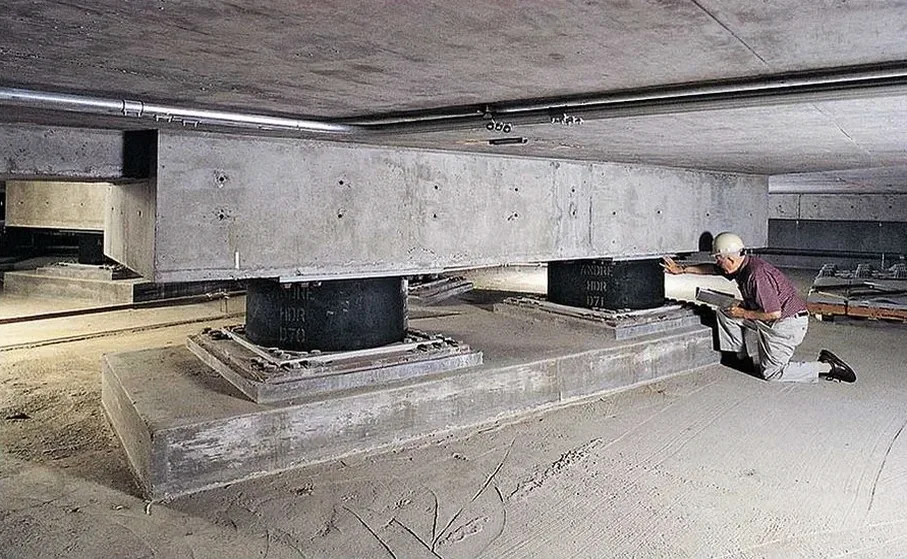
The most frequent misstep we encounter in Bristol projects is the specification of base isolation bearings without a site-specific probabilistic seismic hazard assessment (PSHA), relying instead on generic UK hazard maps that do not capture local soil amplification in the Avon Valley. This can lead to a gross underestimation of the corner-period displacement demand, leaving insufficient moat clearance and risking structural pounding against retaining walls. Another critical failure mode involves ignoring the vertical earthquake component in the design of the isolators, which in stiff Mercia Mudstone sites can produce notable vertical accelerations that compromise the buckling stability of elastomeric bearings. A proper base isolation seismic design must also consider the long-term creep and aging of rubber compounds under the sustained vertical loads typical of Bristol's five-to-eight-storey residential blocks. We have seen retrofit proposals where the existing strip footings were assumed adequate to transfer concentrated isolator reactions, when in reality a detailed footing design check confirmed the need for local strengthening or the introduction of a new reinforced concrete mat above the existing foundations.
Relevant standards
BS EN 1998-1:2004 + UK National Annex (Design of structures for earthquake resistance), BS EN 15129:2018 (Anti-seismic devices — elastomeric and sliding bearings), BS 5930:2015 + A1:2020 (Code of practice for ground investigations — site characterisation for dynamic analysis), ISO 22762:2018 (Elastomeric seismic-protection isolators — test methods and material specification)
Related services
Nonlinear Time-History Analysis and Isolation System Design
We develop a suite of site-specific accelerograms matched to the Bristol uniform hazard spectrum, derived from PSHA that accounts for the attenuation properties of the local Carboniferous basement. Using these ground motions, we perform nonlinear time-history analysis in OpenSees or ETABS to optimise the force-displacement loop of the isolation system, specifying the characteristic strength, post-elastic stiffness, and yield displacement for each bearing type. The output includes the design of the seismic gap, moat covers, and flexible utility connections that accommodate the full design displacement without compromising fire strategy or accessibility.
Prototype Testing Specification and Factory Production Control
Our role extends to drafting the testing protocol in accordance with BS EN 15129, including the type tests for full-scale bearings under the Bristol design displacement history. We review the factory production control documentation and witness the routine tests for the production batch, verifying the compression stiffness, shear modulus, and damping ratio against the design values. This hands-on oversight ensures the as-built isolation devices deliver the assumed hysteretic behaviour in the analysis model, which is particularly important for the lead-core degradation characteristics over multiple cycles in the moderate-magnitude UK scenario.
Typical parameters
Common questions
Is base isolation viable for a 4-storey apartment block in Bristol given the low UK seismicity?
Viability depends on the performance objectives rather than just seismicity. For a standard residential block on a Class C site in Bristol, we typically find that fixed-base design with adequate ductility detailing is sufficient to meet life safety criteria. However, if the client requires immediate occupancy or protection of non-structural components after a 1-in-475-year event — common for build-to-rent schemes — base isolation becomes a cost-effective solution. The incremental cost of the isolation system and the additional foundation works can be offset by reductions in structural steel or reinforcement in the superstructure, as the seismic forces are drastically reduced. We assess this through a comparative life-cycle cost analysis specific to each Bristol site.
What ground investigation is required before starting a base isolation design in Bristol?
Beyond a standard geotechnical investigation, we require a detailed seismic site characterisation that includes a MASW survey to measure the shear wave velocity profile (Vs30) and establish the site class per BS EN 1998-1. In the Avon Valley, where alluvial deposits overlie bedrock, we often complement this with a CPT test to map the impedance contrast between the soft soils and the stiffer underlying material, which directly influences the amplification factor. A minimum of one deep borehole to 30 m, logged by an engineering geologist familiar with the Mercia Mudstone weathering profile, is essential to confirm the ground model used in the site response analysis.
How do you ensure the isolation bearings perform over the 50-year design life of a Bristol building?
We specify elastomeric bearings with a proven aging resistance, referencing the accelerated aging test protocols in ISO 22762. The rubber compound formulation must demonstrate adequate ozone and UV resistance, which is relevant even in Bristol's temperate climate due to long-term exposure in ventilated basement moats. We also require the bearing manufacturer to provide a 10-year warranty on the mechanical properties, with a defined replacement and inspection strategy. The design includes access galleries and jacking points around each isolator, allowing for periodic inspection and, if ever necessary, replacement under controlled conditions without demolishing the superstructure.
What is the typical cost range for base isolation seismic design for a project in Bristol?
For a mid-rise building in Bristol, the full design package — including dynamic site characterisation, nonlinear analysis, bearing specification, and testing oversight — typically falls between £2,850 and £7,440, depending on the structural irregularity and the number of isolators to be individually modelled. This is the engineering design fee, distinct from the supply and installation cost of the isolation bearings themselves, which we can help estimate once the preliminary design is complete.
Can base isolation be retrofitted to an existing listed building in Bristol?
Yes, and we have worked on feasibility studies for heritage structures in the Clifton and Redcliffe areas where conventional strengthening would have compromised the architectural fabric. The retrofit involves temporarily supporting the structure on jack piles, cutting the existing columns or walls at a new isolation plane, and inserting the bearings. The main challenge in Bristol's listed buildings is the low strength of historic lime mortar masonry, which requires careful load spreader design above each isolator. A detailed condition survey and material testing programme always precedes the isolation design in these projects.