BS 5930:2015+A1:2020 and Eurocode 7 require reliable ground investigation before any foundation design in the UK. In Bristol, this means dealing with the Mercia Mudstone Group, Triassic sandstones, and the thick alluvial clays of the Avon Valley. We run CPT (Cone Penetration Test) campaigns that deliver continuous profiles of tip resistance, sleeve friction, and pore pressure. The data feeds directly into bearing capacity calculations and settlement analysis. In the Floating Harbour area, where historical fill overlies soft estuarine deposits, CPT readings often reveal sharp impedance contrasts that standard boreholes miss. We pair this with grain size analysis when thin sand lenses appear in the log, and with triaxial testing to calibrate undrained shear strength from cone factors in the deeper clays. BS EN 1997-2:2007 governs our interpretation framework. Every cone is calibrated to ISO 22476-1:2012 standards before mobilization. We operate a 20-tonne CPT truck with continuous push capability, which handles the stiff transition into weathered mudstone that stops lighter rigs.
A CPT profile in Bristol's alluvial clays gives you a continuous strength signature that no SPT can match. You see the weak layer before you ever sample it.
How we work
Local ground factors
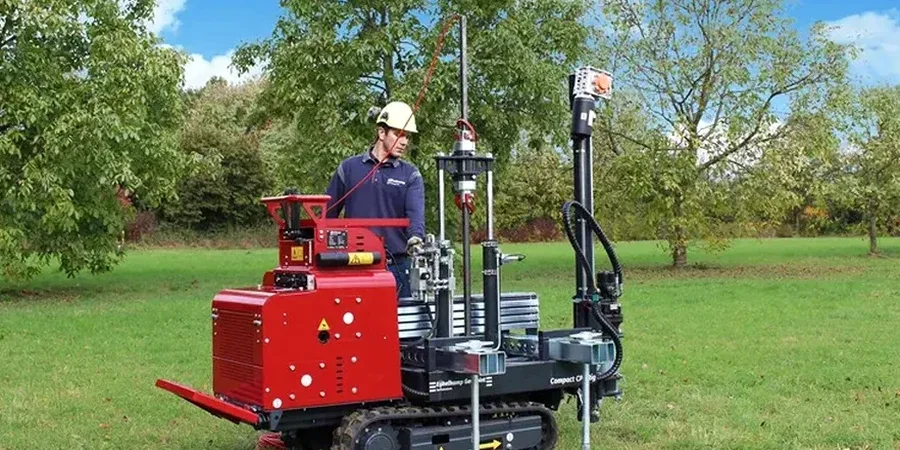
Our CPT truck is a 20-tonne, all-wheel-drive unit with a hydraulic push system rated for 200 kN continuous force. In Bristol, the main operational risk is refusal on buried masonry or cobbles in the made ground. The Floating Harbour and St Philip's areas are notorious for 19th-century brick rubble and timber piles. If the cone hits a hard obstruction at shallow depth, the push rods can buckle. We mitigate this by pre-drilling through the upper 2–3 metres with a rotary auger where historical maps indicate fill. Another risk is rod friction in the swelling Weathered Mercia Mudstone. When the clay takes up water from the drilling fluid, it clamps the rods. We monitor push force and inclination continuously. A bent rod is a data-quality problem and a safety hazard. We abort the push at 5° deviation and reposition. For sites near the tidal Avon, we schedule CPT during low tide to avoid artesian conditions that cause blowout around the cone.
Process video
Relevant standards
BS 5930:2015+A1:2020 (Code of practice for ground investigations), BS EN 1997-2:2007 (Eurocode 7 – Ground investigation and testing), ISO 22476-1:2012 (Geotechnical investigation and testing – Field testing – Part 1: Electrical cone and piezocone penetration test)
Related services
Piezocone (CPTu) Profiling
Continuous qc, fs, and u2 logs with SBT classification. We run dissipation tests at specified depths to estimate consolidation rates in the Avon Valley silts.
Seismic CPT (SCPTu)
Downhole shear wave velocity measurement every 1 m during cone pauses. Provides Vs for site class per BS EN 1998-1 and small-strain stiffness for foundation settlement.
CPT with Soil Sampling
We combine CPT with targeted window sampling or rotary coring where soil type requires laboratory validation. Sample depths are picked from real-time CPT logs.
Interpretative Reporting
We deliver AGS 4 data files, SBTn charts, Su and OCR profiles, and direct foundation recommendations for pad footings and piles per BS 8004.
Typical parameters
Common questions
How much does a CPT in Bristol cost?
A standard CPTu profile to 15–20 metres in the Bristol area typically costs between £120 and £180 per linear metre, depending on access conditions, traffic management requirements, and whether you need dissipation testing or seismic add-ons. We provide a fixed quote after reviewing the site location and expected ground conditions.
How deep can you push the cone in Bristol's geology?
In the Avon Valley alluvium we routinely reach 18–22 metres before encountering weathered mudstone. In Clifton or Redland where Carboniferous limestone is shallow, refusal occurs between 3 and 8 metres. We run the push at 2 cm/s standard rate and stop at 5° rod inclination or tip resistance exceeding 50 MPa.
Do I still need boreholes if I use CPT?
CPT gives you continuous stratigraphy and strength profiles, but it doesn't recover samples. For most projects we recommend a combined approach: CPT for detailed profiling and a smaller number of boreholes or test pits for material identification and laboratory testing. BS 5930 endorses this hybrid method.
What information do I get from the CPT for pile design?
You get sleeve friction and tip resistance profiles that feed directly into ICP-05 or Fugro-05 pile capacity methods. We also provide the undrained shear strength profile for clay layers and the relative density profile for sand lenses. This lets your designer size piles and estimate settlement without conservative assumptions from SPT correlations alone.