In Bristol, many sites sit on a weathered profile of Mercia Mudstone or the stiffer Carboniferous limestone that forms the Avon Gorge. The city's topography — shaped by the Rivers Avon and Frome cutting through bedrock — means retaining wall design here rarely follows a textbook approach. A 3-metre cut in Clifton behaves differently than one in the alluvial flats near Temple Meads. Groundwater perched within mudstone beds and the presence of historic fill from Victorian-era docks add further complexity. The technical team addresses these variables through ground investigation programmes that feed directly into limit state analysis under Eurocode 7. Before committing to a wall type, we often integrate findings from a trial pitting campaign to map the depth to competent rock, which governs both bearing and sliding resistance in the final retaining wall design.
In Bristol, the difference between a successful retaining wall and a problematic one often lies in how well perched groundwater is managed behind the stem.
How we work
Design parameters were calibrated against BS EN 1997-1:2004 Design Approach 1, checking both short-term undrained and long-term drained conditions. Partial factors for actions and material properties were applied per UK National Annex. The wall stem was proportioned using bending moment envelopes from active earth pressure diagrams, factoring in a uniform surcharge of 10 kPa for adjacent garden areas. These decisions reflect the iterative nature of retaining wall design in Bristol's mixed ground — where the solution is never just about the wall itself, but about how water, fill history, and slope geometry interact over the structure's design life.
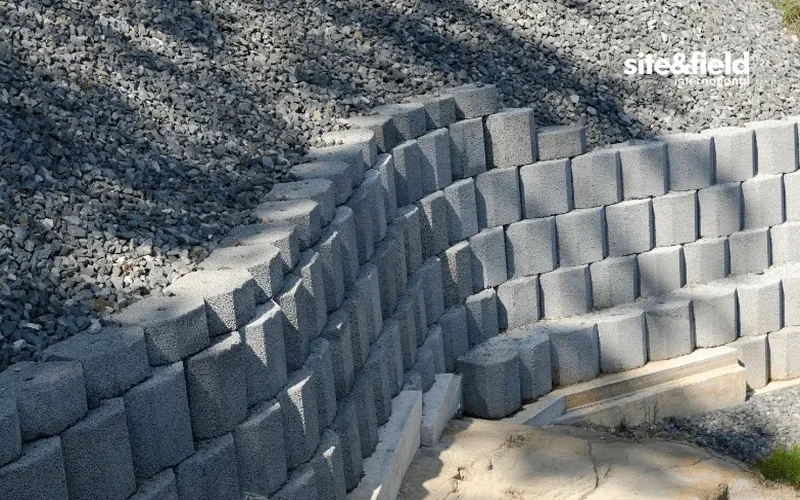
Local ground factors
BS EN 1997-1:2004 requires that both ultimate and serviceability limit states be verified for retaining structures, and in Bristol this takes on specific meaning. The Mercia Mudstone Group weathers rapidly when exposed; a temporary excavation left unsupported through a wet winter can lose significant strength at the face, altering the earth pressure diagram assumed in the retaining wall design. Global stability checks become essential where the wall is founded near a slope break, particularly in areas like Totterdown or the Avon valley sides where natural gradients exceed 1:3. Overturning, bearing capacity failure, and excessive forward rotation are the three mechanisms most frequently underestimated when ground conditions are inferred rather than measured. A retaining wall design that omits a solid drainage strategy — or that relies on weep holes without a continuous granular chimney — will accumulate hydrostatic pressure behind the stem, a condition that has caused serviceability failures in several Bristol basement projects over the past decade. The cost of remediation far exceeds the cost of proper investigation and conservative detailing from the outset.
Relevant standards
BS EN 1997-1:2004 (Eurocode 7: Geotechnical design – General rules, with UK National Annex), BS 5930:2015 (Code of practice for ground investigations), BS 8002:2015 (Code of practice for earth retaining structures), BS EN 1992-1-1:2004 (Design of concrete structures, for stem and base reinforcement)
Related services
Feasibility and wall type selection
Comparative assessment of gravity, cantilever, counterfort, and embedded retaining walls based on site geometry, ground conditions, and access constraints in Bristol's urban and hillside settings.
Detailed retaining wall design and detailing
Limit state analysis to Eurocode 7 including sliding, overturning, bearing, and global stability checks. Production of reinforcement drawings, drainage details, and construction specifications.
Construction-phase support and monitoring
Technical review of temporary works proposals, response to ground condition changes during excavation, and installation verification for drainage and backfill compliance.
Typical parameters
Common questions
How much does retaining wall design cost for a typical Bristol residential project?
For a permanent retaining wall up to 3 metres retained height on a standard Bristol residential plot, the design fee typically falls between £790 and £3,790 depending on the complexity of ground conditions, the number of limit states requiring verification, and whether the wall is subject to building control approval or a full structural warranty review.
Do I need planning permission for a retaining wall in Bristol?
Planning permission is not automatically required for all retaining walls, but Bristol City Council will assess the impact on neighbouring properties, highways, and protected landscapes such as the Avon Gorge or conservation areas. Walls exceeding 1 metre in height adjacent to a highway, or 2 metres elsewhere, often trigger planning or building regulation consultation. We recommend checking with the council's planning portal early in the process.
What ground investigation is needed before retaining wall design starts?
A ground investigation proportionate to the wall height and site sensitivity is essential. In Bristol, this typically involves trial pits to log the weathered profile and identify the top of competent Mercia Mudstone or limestone, combined with laboratory testing for shear strength parameters (drained and undrained). For walls over 3 metres, boreholes with SPTs and sampling for triaxial testing provide the data needed for reliable limit state analysis.
How long does the design process take from instruction to issue of drawings?
For a straightforward cantilever wall with ground investigation data already available, detailed design and drawing production can be completed within three to four weeks. Where additional site investigation is required, or where the wall forms part of a larger basement or slope stabilisation scheme, the programme extends by the time needed for fieldwork and laboratory testing — typically adding two to four weeks.