Bristol sits in a geological basin where Carboniferous limestone, Triassic mudstone, and thick alluvial deposits along the Avon Valley create some of the most varied excavation conditions in the southwest. With the city's population growing past 472,000 and major regeneration reshaping areas from Temple Quarter to Bedminster, ground engineers face a genuine puzzle: how to cut deep into unstable ground without affecting adjacent heritage structures. A rigorous excavation monitoring programme becomes essential when the dig goes below the water table, and we integrate that data with the design from day one. The team runs the analysis on PLAXIS and WALLAP, calibrating every model against borehole logs and laboratory strength tests so the temporary works actually reflect what the ground will do. No two sites in Bristol behave the same, and pretending otherwise is what gets projects into trouble.
A well-calibrated excavation model saves more in avoided remedial works than it costs in investigation — and in Bristol's mixed ground, calibration is everything.
How we work
Local ground factors
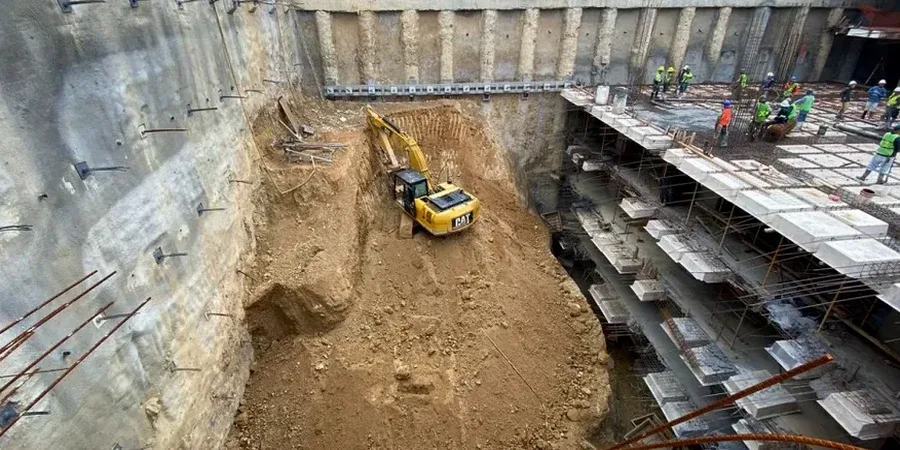
The contrast between Clifton's limestone plateau and the soft clays of St Philips tells the whole story. Up on the heights, a deep excavation hits competent rock within a few metres, and the main risk is overbreak in fractured zones rather than global instability. Down in the valley, the same cut depth puts you into normally consolidated silty clay with a shear strength that drops fast when the excavation stays open too long. The biggest cost overrun we see is not the design fee: it is the emergency backfill when a benched slope in weathered Mercia Mudstone starts to ravel after a wet weekend. Stone columns can improve the basal stability in those conditions, but they need to be designed and installed before the dig starts, not as a reactive fix. The observational method written into Eurocode 7 gives a framework for managing this uncertainty, provided the trigger levels and contingency actions are defined in the design report rather than improvised on site.
Process video
Relevant standards
BS EN 1997-1:2004 (Eurocode 7: Geotechnical design — Part 1: General rules), BS EN 1997-2:2007 (Eurocode 7: Ground investigation and testing), BS 8002:2015 (Code of practice for earth retaining structures), BS 5930:2015 + A1:2020 (Code of practice for ground investigations), CIRIA C760 (Guidance on embedded retaining wall design)
Related services
Embedded retaining wall design
Analysis of contiguous bored pile, secant pile, and diaphragm walls up to 25 m depth, including prop and anchor layouts optimised for the Avon Valley's alluvial sequence and limestone interface.
Groundwater control and dewatering
Design of temporary and permanent dewatering systems with transient seepage analysis, addressing the variable permeability across the Mercia Mudstone and underlying Carboniferous limestone.
Construction-stage monitoring integration
Specification of inclinometer arrays, load cells, and vibration monitoring linked to trigger-action response plans, keeping the observational method firmly within the design envelope.
Typical parameters
Common questions
How much does a deep excavation design cost in Bristol?
For a typical basement or shaft in Bristol, the geotechnical design of deep excavations ranges from £1,840 to £6,460 depending on depth, wall type, and the complexity of the ground model. A 3-metre cut in competent limestone sits at the lower end; a 12-metre basement in Avon alluvium with contiguous piles, props, and dewatering design sits at the upper end. The fee covers the ground investigation interpretation, FEM analysis, wall sizing, propping sequence, groundwater control, and a construction-ready report with staging drawings.
What makes Bristol's geology challenging for deep excavations?
The rapid transition from Carboniferous limestone on the northern heights to thick alluvial clays along the Floating Harbour and Avon Valley means two sites half a mile apart can behave completely differently. In the city centre, made ground overlying tidal flat deposits and buried channels creates perched water tables and variable bearing strata that complicate both temporary works design and groundwater control.
Which design standard do you follow for retaining walls?
All designs comply with BS EN 1997-1:2004 (Eurocode 7) using Design Approach 1 for the UK National Annex. For earth retaining structures specifically, we apply BS 8002:2015, and for embedded walls the guidance in CIRIA C760 is the standard reference. Ground investigation follows BS 5930:2015 + A1:2020.
Do you handle the Building Control approval for excavation designs?
We produce the geotechnical design package with full calculation reports, ground investigation interpretation, and construction-stage drawings suitable for submission to Bristol City Council Building Control. The design is prepared under the responsibility of a chartered civil engineer, and we respond to technical queries during the approval process at no extra charge for a standard review cycle.