A residential cut-and-fill job up in Clifton last autumn ran into serious trouble. The contractor had compacted the platform with a heavy roller, passes counted and water added by eye, but the chalk marl just wouldn’t hold. Three weeks later the pad settled 40 mm and cracked the drainage. What they were missing was a straightforward Proctor test to pin down the optimum moisture content and maximum dry density for that specific borrow material. Across Bristol’s undulating terrain—from the limestone ridges of the Downs to the softer Mercia Mudstone in the Avon valley—the response to compaction effort changes radically. Running a sand cone density test alongside the Proctor gives field verification that the lab number is being hit on the lifts, something we insist on when the spec calls for 95% relative compaction under a reinforced footing or a pavement sub-base.
Compaction isn’t about maximum density. It’s about density at the moisture content the material will actually see in service across Bristol’s wet winters.
How we work
Local ground factors
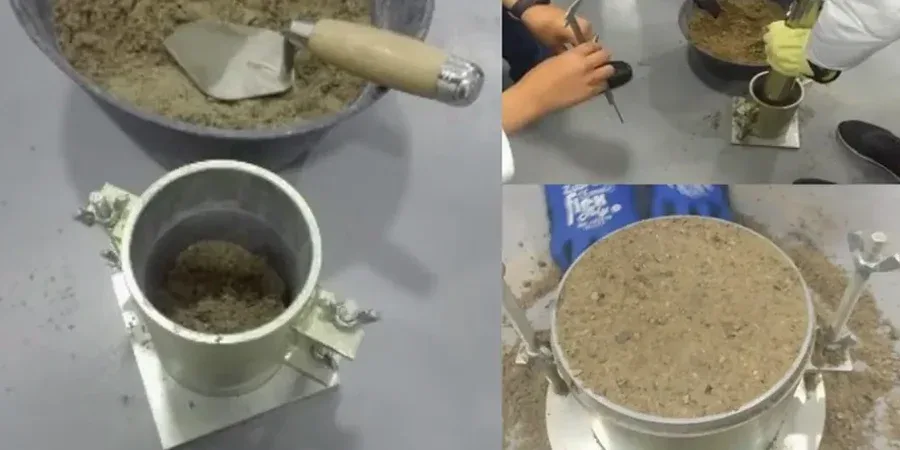
The lab equipment is deceptively simple: a steel mould, a collar, a calibrated rammer that slides on a guide sleeve, and a balance reading to 1 g. The risk hides in sample preparation. If the material is dried too aggressively—left in a 105°C oven until bone-dry on a Friday afternoon—the clay fraction can irreversibly change and the Proctor curve will lie. We air-dry Bristol samples wherever possible, especially the Lias clays from sites near Temple Meads. Another hazard is oversized particles. A single cobble left in the mix, or a decision to scalp at 37.5 mm instead of 20 mm without adjusting the spec, shifts the entire compaction curve rightward. On a motorway embankment near the M32 corridor, that error translated into a 3% density shortfall and a costly re-roll. The Proctor is simple in principle; getting it right demands careful specimen handling, correct energy calibration, and a clear chain of custody from the test pit or stockpile to the lab bench.
Process video
Relevant standards
BS 1377-4:1990 – Compaction-related tests, BS 5930:2015+A1:2020 – Code of practice for ground investigations, Eurocode 7 (BS EN 1997-2:2007) – Ground investigation and testing, Manual of Contract Documents for Highway Works (MCHW) Series 600
Related services
Standard and Modified Proctor
Determination of the moisture–density relationship using the 2.5 kg or 4.5 kg rammer. Includes OMC, MDD, and zero-air-voids curve. Turnaround in 48 hours, with same-day preliminary data when the programme is tight.
Field density verification
Sand replacement or nuclear densometer testing on compacted lifts, referenced directly to the Proctor curve. We provide relative compaction percentages and moisture deviation reports formatted for RE acceptance.
Typical parameters
Common questions
What does a Proctor test cost in Bristol?
For a single Standard or Modified Proctor determination, budget between £80 and £200 depending on material type, sample preparation time, and whether the test is part of a larger investigation package. Same-day preliminary data may carry a small surcharge.
Which Proctor variant should I specify for Bristol Mercia Mudstone?
Standard Proctor (2.5 kg rammer) usually gives a more realistic compaction target for weak mudstones. Modified Proctor can crush the lithorelicts and produce an artificially high MDD that cannot be replicated in the field with conventional plant.
How long does the lab test take from sample drop-off?
Full reporting within two working days is standard. If the material requires extended air-drying or careful scalping, allow an extra day. We can provide the OMC and MDD figures by phone or email within 24 hours for urgent earthworks decisions.
Can you test material with particles larger than 20 mm?
BS 1377-4 limits the standard Proctor mould to 20 mm material. For fills containing oversize, we scalp the sample and apply a correction factor, or discuss alternative large-mould compaction methods if the percentage retained is significant.
Do you carry out CBR testing on the same sample?
Yes. Once the Proctor curve is established, we can compact specimens at the target moisture and density for soaked or unsoaked CBR determination to the MCHW Series 600 specification, saving time and sample volume.